Article: 1.60 vs. 1.67 vs. 1.74 Lenses for Rimless Glasses
1.60 vs. 1.67 vs. 1.74 Lenses for Rimless Glasses
For rimless glasses, 1.60, 1.67, and 1.74 are different lens-material indexes. A higher index can often produce a thinner lens for the same prescription, but the highest number is not automatically the best choice. Your full prescription, chosen lens width and height, lens design, optical measurements, and available treatments all influence the finished result.
That matters with rimless eyewear because the lens edge is visible. A thoughtful lens choice can help balance appearance, weight, clarity, durability, and budget without choosing more material than your prescription needs.
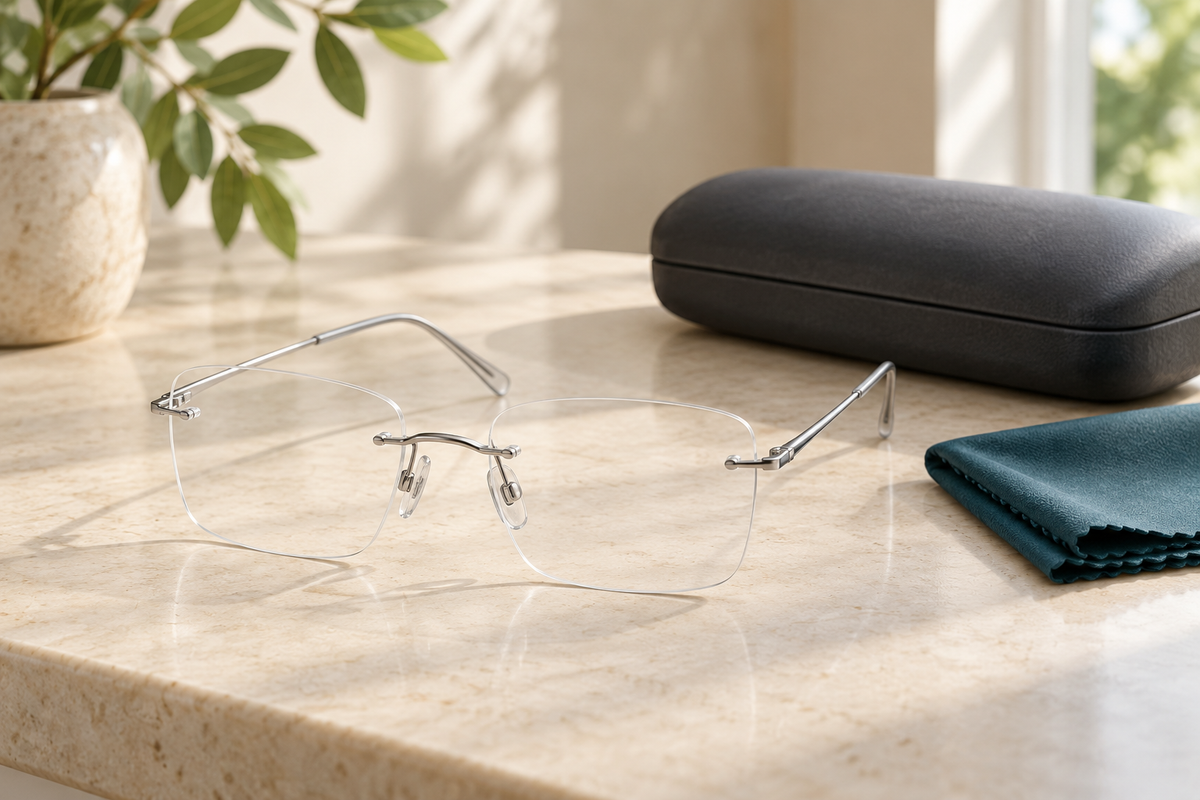
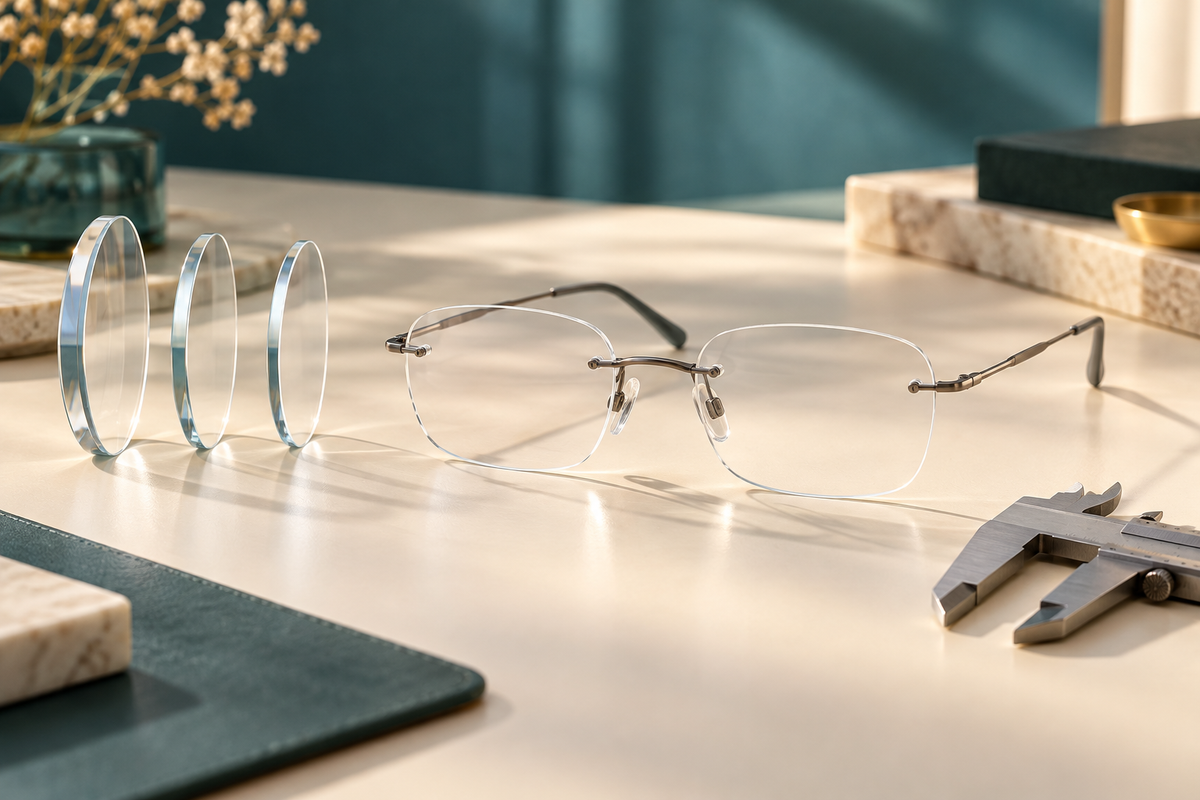
Main image: AI-generated editorial illustration showing the concept of lens-edge thickness; it is not a photograph or measured comparison of specific Rimless Wear products.
What does lens index mean?
Lens index describes how efficiently a lens material bends light. In many prescriptions, a higher-index material can provide the required correction with less curvature or thickness than a lower-index material. The finished lens is not determined by index alone, however.
Two people ordering the same index can receive lenses with visibly different edges because their prescriptions, pupil positions, lens shapes, and sizes are different. Plus prescriptions tend to be thickest near the center; minus prescriptions tend to be thickest toward the edge. This is why a useful recommendation starts with the complete prescription rather than one number.
1.60 vs. 1.67 vs. 1.74 at a glance
| Lens index | Practical role | Question to consider |
|---|---|---|
| 1.60 high index | A thinner-lens option that can offer a balanced starting point for many prescriptions. | Does your prescription and chosen size need more thinning? |
| 1.67 high index | A higher-index choice when reducing visible thickness is a stronger priority. | Will the benefit be noticeable for your prescription and lens dimensions? |
| 1.74 super high index | The highest-index option currently listed by Rimless Wear, intended when maximum thinning is being considered. | Is it available and appropriate for your complete lens configuration? |
Rimless Wear currently lists 1.60 High Index, 1.67 High Index, and 1.74 Super High Index. Availability can depend on the prescription, lens type, coating, tint, and other selections made during the order.
Why lens size matters in rimless glasses
A larger lens uses more material across a wider area, so its finished thickness and weight can change even when the prescription and index stay the same. With rimless glasses, the frame design does not determine the lens shape. You can choose a frame style, then customize the lens shape, size, and overall look.
That freedom is useful when managing thickness. For example, a customer may love a wide geometric lens but also want a lighter edge appearance. A slightly smaller version of the same shape—or a different proportion—may help. The goal is not simply “small is better”; it is to find a shape and size that works with the prescription and the desired style.
Explore the choices on the custom rimless glasses page, then use Live Try-On to compare proportions. The preview helps with style; final lens recommendations still depend on the prescription and measurements supplied with the order.
Four factors to check before choosing an index
- Your complete prescription: Sphere, cylinder, axis, ADD, prism, and the relationship between both eyes may affect what is suitable.
- Your selected lens dimensions: Overall width, lens width, and height influence how much material is needed and where thickness appears.
- Your lens design: Single-vision, progressive, and bifocal lenses have different design requirements. Progressive lenses also need enough usable height for their viewing zones.
- Your lens features: Anti-reflective coatings, photochromic options, tints, polarization, and other treatments have their own compatibility and availability.
Because several variables work together, a recommendation based only on “strong” or “weak” prescription language can be misleading. Rimless Wear can review your prescription and desired width to help narrow the suitable choices.
Does higher index always mean lighter?
Not necessarily. Higher index can reduce the amount of material needed, but material density and the final lens dimensions also affect weight. A smaller well-planned lens in one index may feel lighter than a larger lens made in a higher index. The right comparison is the finished design, not the index number by itself.
Should high-index lenses have anti-reflective coating?
Higher-index materials can reflect more light than standard materials. An anti-reflective treatment can reduce distracting reflections and improve the appearance of clear lenses. Check the available coating choices during lens customization because compatibility and selection can vary.
How to choose without guessing
Start with the style you want, choose a lens shape, select the preferred size, and provide your complete prescription and measurements. If you are deciding between two indexes, ask which choices are appropriate for that exact combination rather than upgrading automatically.
You can begin your order and review the available lens options step by step. For help before ordering, contact Rimless Wear with your prescription and preferred width. This is general product guidance, not individualized medical advice; questions about eye health or prescription accuracy belong with your eye-care professional.
Frequently asked questions
Is 1.74 always thinner than 1.67?
When comparing the same prescription, design, and dimensions, 1.74 is generally selected for greater thinning potential. Actual finished thickness still depends on the full lens calculation.
Can I choose a different lens shape to reduce edge thickness?
Sometimes a different shape or smaller size can help manage visible edge thickness, especially for minus prescriptions. The effect depends on prescription and pupil position, so the shape should be reviewed as part of the complete design.
Does my frame model decide my lens shape?
No. With Rimless Wear, the frame design and lens shape are separate choices. You can customize the shape, size, and style, subject to prescription and manufacturing suitability.
Which index should I choose for progressive rimless glasses?
There is no single index for every progressive prescription. The ADD, distance prescription, selected shape, lens height, measurements, and available lens design all need to work together.
Sources and availability check
Checked October 8, 2026. Rimless Wear product availability was verified against the current 1.60, 1.67, and 1.74 listings. General material guidance was reviewed against ZEISS high-index lens information and HOYA lens-material information.