Are Titanium Rimless Glasses a Good Choice? A Practical Guide
Yes—titanium rimless glasses can be an excellent choice when you want a light, minimal frame with a strong strength-to-weight balance and good resistance to corrosion. Titanium is especially well suited to rimless eyewear because the visible frame is reduced to the bridge, temples, hinges, nose-pad arms, and small lens mountings.
Material is only one part of a good pair, however. Comfort and durability also depend on the lens material, prescription, lens size, mounting design, measurements, adjustment, and daily care. Titanium makes a thoughtful foundation; it does not make glasses indestructible.
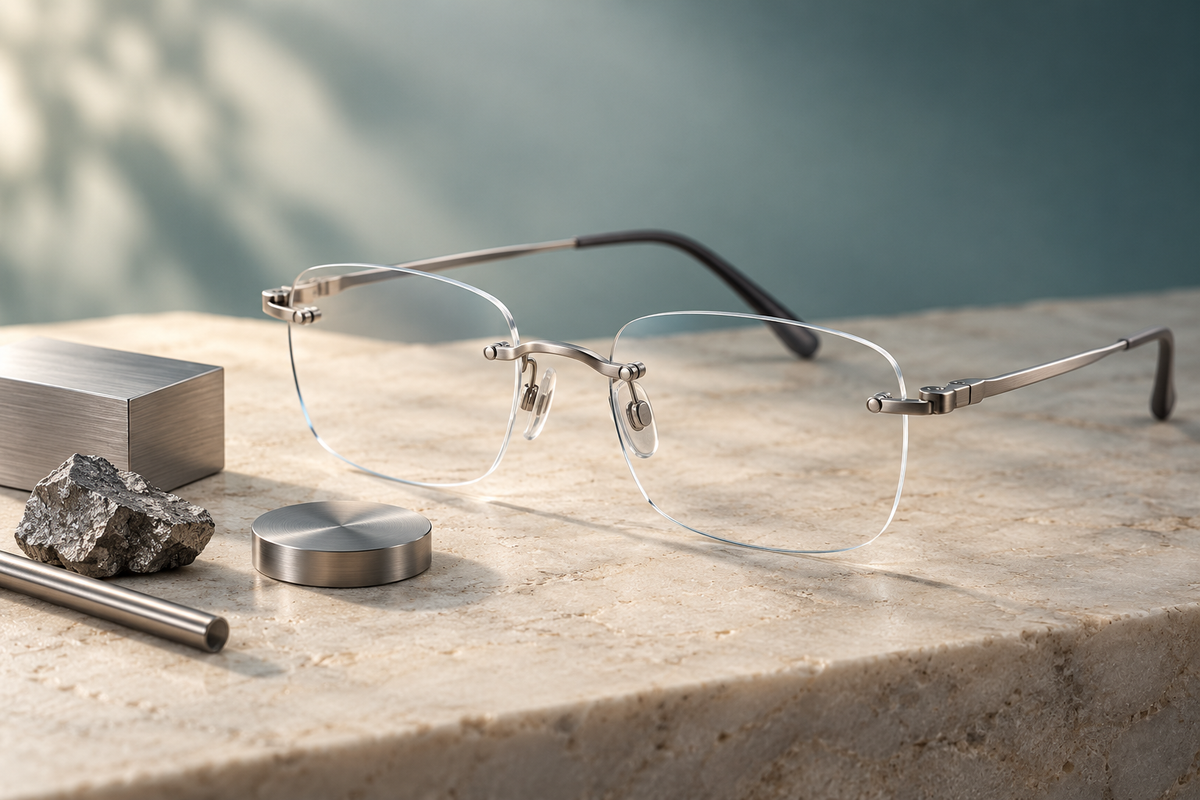
Main image: AI-generated editorial illustration showing titanium rimless eyewear and material samples. It is not a photograph of a Rimless Wear product or customer order.
Why is titanium used for rimless glasses?
Titanium combines three useful material qualities: it is relatively light, strong for its weight, and resistant to corrosion. Those properties are valuable in eyewear, where small parts must support the lenses without adding a heavy or bulky look.
In a full-rim frame, the front rim surrounds and supports each lens. A rimless design has no surrounding rim, so the bridge and temples attach directly to drilled points in the lenses. Using a light, capable metal for these components helps preserve the barely-there appearance that attracts many people to rimless glasses.
1. A lighter frame can feel less noticeable
Titanium has a lower density than steel, so it can help reduce the weight of the metal components. Rimless construction already removes the material that would normally surround the lenses. Together, these choices can create a pair that feels visually and physically light.
The final weight still depends heavily on the lenses. A larger lens, stronger prescription, thicker edge, or dense lens material can add more weight than the bridge and temples. If a light finished pair is the priority, consider the complete combination rather than choosing the frame material in isolation.
2. Titanium offers a useful strength-to-weight balance
Eyewear needs small components that can hold their shape through regular use. Titanium is valued for providing strength without requiring the same mass as many heavier metals. That makes it practical for slender bridges and temples.
Strength does not mean damage-proof. Rimless glasses can still be affected by twisting, impact, sitting on them, forcing them into a case, or repeatedly handling one temple. The lens mounting points and drilled lenses are part of the structure, so the whole pair should be handled with both hands.
3. Corrosion resistance suits everyday wear
Titanium naturally forms a stable surface oxide layer that gives it good corrosion resistance. For eyewear, this is useful because frames encounter skin oils, perspiration, humidity, and occasional splashes.
Corrosion resistance is not a reason to skip cleaning. Residue can collect around nose pads, screws, hinges, and mounting points. Rinse or clean the glasses according to the lens-coating instructions, dry them with a clean microfiber cloth, and avoid household chemicals. For a complete routine, see the rimless glasses cleaning guide.
4. The minimalist finish works with many styles
Titanium can be finished in restrained neutrals such as silver, gunmetal, black, gold, or bronze, as well as more expressive colors depending on the frame. Because there is no full rim around the lenses, the metal color acts as a small accent rather than dominating the face.
For a quiet professional look, consider silver, gunmetal, or a slim gold tone. For more personality, choose a stronger color or a distinctive bridge. Rimless styling can be subtle or bold; the lens outline and size often change the impression more than the amount of metal.
5. Frame design and lens shape are separate choices
The titanium frame design does not determine the lens shape. At Rimless Wear, you choose the bridge-and-temple style, then personalize the lens shape, size, and available lens options separately. A single titanium frame can therefore work with a soft round shape, a clean rectangle, an oval, a geometric outline, or a customer-designed shape when the complete configuration is suitable.
This is one of the most useful differences between rimless and conventional full-rim eyewear. You are not limited to the sample lens shown with a frame. Explore the current rimless frame selection, then refine the lens outline and proportions around your style, measurements, and prescription.
6. Titanium does not decide prescription suitability
The frame material does not determine whether a prescription can be made. Prescription suitability depends on the lens material and index, lens shape and dimensions, prescription values, optical measurements, and the mounting requirements.
For stronger prescriptions, lens size and high-index material can affect thickness and finished weight. Progressive lenses also need enough usable height for the viewing zones. The titanium frame remains the attachment system; the lenses do most of the optical work.
If you are comparing lens materials, read the guide to 1.60, 1.67, and 1.74 lenses for rimless glasses. For multifocals, see the progressive rimless fit guide.
7. The exact construction still matters
“Titanium frame” describes the material category, not every engineering detail. Temple flexibility, hinge construction, nose-pad design, number of mounting points, finishes, and component combinations vary by model. Some titanium frames have flexible temples; others are intentionally more structured.
For example, Rimless Wear’s current B2B titanium rimless frame guide describes flexible temples, adjustable nose pads, customizable lens shapes and sizes, and an eight-hole mounting design. Other collections may use different proportions or details. Compare the actual frame specifications rather than assuming all titanium eyewear behaves identically.
What about sensitive skin or metal allergies?
Titanium is widely used when a corrosion-resistant metal is desired, but “titanium” does not automatically describe every component, alloy, coating, solder, screw, or nose-pad part in a finished frame. Anyone with a known metal sensitivity should ask about the exact materials that contact the skin and discuss medical concerns with a qualified clinician. This guide is general product information, not individualized medical advice.
How to choose a titanium rimless frame
- Start with the bridge and temple style: Decide whether you prefer a slim, double-bridge, classic, or more expressive look.
- Choose a color: Pick a metal finish that works with your everyday wardrobe and preferred level of contrast.
- Select the lens shape separately: Remember that the sample shape does not lock the frame into that outline.
- Refine the size: Use physical measurements and an existing comfortable pair as references. Live Try-On can help compare appearance, but it does not replace measurements.
- Match the lenses to the prescription: Consider index, thickness, weight, coatings, and sufficient height for multifocals.
- Review the full configuration: The best result comes from the frame, lenses, mountings, and measurements working together.
Rimless Wear’s custom rimless glasses guide explains how shape, size, prescription choices, and lens options come together in the ordering process.
Frequently asked questions
Are titanium rimless glasses lighter than regular glasses?
They can be. Titanium helps keep the metal components light, and rimless construction removes the surrounding lens rims. The finished weight also depends on the lens material, prescription, shape, and size.
Are titanium rimless glasses durable?
Titanium provides a strong, corrosion-resistant frame foundation, but durability depends on the entire construction and how the glasses are handled. The drilled lenses and mounting points still require appropriate care.
Can titanium rimless glasses use prescription lenses?
Yes, when the chosen lens material, shape, dimensions, prescription, and mounting system are compatible. Single-vision, multifocal, clear, sun, and photochromic configurations may be available depending on the complete order.
Can I change the lens shape on a titanium rimless frame?
Yes. The frame design does not determine the lens shape. You can choose the shape, refine its size, and even submit your own outline, subject to prescription and manufacturing suitability.
Do titanium frames never bend or break?
No material is indestructible. Titanium has useful mechanical properties, but glasses can still be damaged by impact, twisting, poor adjustment, or stress at the lens mountings. Use both hands to put them on and store them in a protective case.
Source and availability check
Checked October 11, 2026. Rimless Wear’s titanium offerings, customization options, and current frame information were verified against its active catalog and customer-facing pages. General titanium properties were cross-checked with the Japan Titanium Society’s material guidance.