
News / October 21, 2026
What Do Glasses Size Numbers Mean? A Rimless Fit Guide
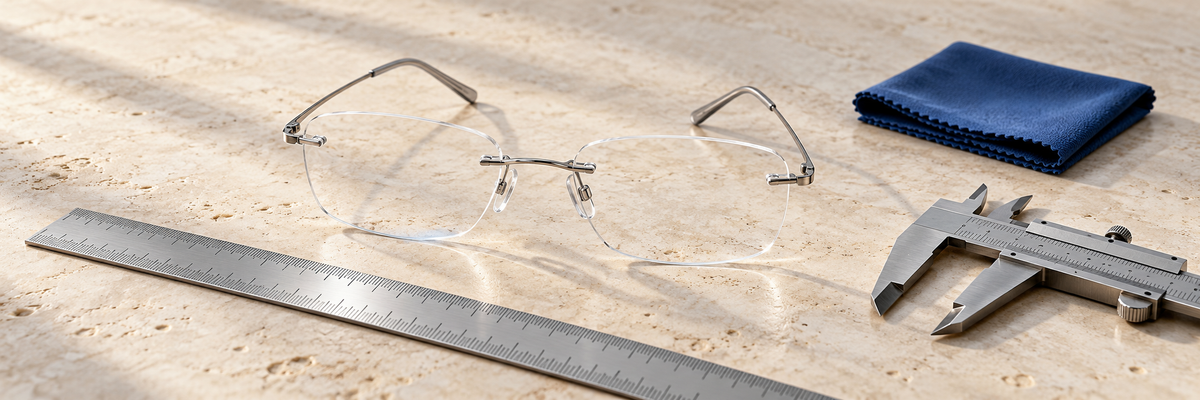
A glasses size such as 52-18-140 usually describes three measurements in millimeters: lens width, bridge width and temple length. For custom rimless glasses, two more measurements are especially useful: the hinge-to-hinge frame width and the lens height.
These numbers are a starting point, not a complete fit guarantee. Lens shape, nose-pad position, bridge construction and the way the temples sit can make two pairs with similar numbers feel or look different.
Cover image: AI-generated conceptual illustration. The eyewear is not an actual Rimless Wear product.
What does 52-18-140 mean on glasses?
Read the numbers from left to right:
- 52 mm — lens width: the widest horizontal measurement of one lens.
- 18 mm — bridge width: the distance between the two lenses at their closest points.
- 140 mm — temple length: the length of an arm from the hinge to its tip, including the bend.
You may find a similar code printed inside a temple arm or on the bridge of an existing pair. Use it as a reference, but do not assume that every printed number is a size. A model number, color code or production code can appear nearby. When the markings are unclear, measure the pair directly in millimeters.
The five measurements worth recording
| Measurement | What it describes | Why it helps with rimless glasses |
|---|---|---|
| Lens width | Widest horizontal point of one lens | Controls the horizontal scale of the lens shape |
| Bridge width | Closest distance between the lenses | Helps describe the spacing at the center of the frame |
| Temple length | Hinge to the end of the arm | Helps compare how the temples reach and sit behind the ears |
| Hinge-to-hinge width | Distance across the front from one hinge to the other | Provides a practical reference for the overall width on your face |
| Lens height | Tallest vertical dimension of one lens | Affects the visual proportions and can matter for multifocal lens designs |
Rimless Wear’s frame and lens sizing guide uses hinge-to-hinge width as the main frame-width reference. That makes it especially useful when comparing a custom pair with glasses you already wear comfortably.
Why the three printed numbers are not the whole story
The familiar three-number code does not normally tell you the complete front width or lens height. It also does not describe how rounded, angular, narrow or deep the lenses are.
For example, two lenses can both be 52 mm wide, while one is a shallow rectangle and the other is a taller rounded shape. They share a width, but they will have different proportions and a different visual presence.
The bridge number is also not a promise of identical nose fit. Nose-pad position, pad adjustment and the bridge’s construction all contribute to how a pair sits. Compare several measurements together instead of relying on one number.
Frame design does not determine your lens shape
With custom rimless eyewear, the bridge and temple design form the hardware foundation, but they do not lock you into one lens silhouette. At Rimless Wear, customers can choose the frame style, then personalize the lens shape, width and height within the available customization and manufacturing requirements.
That means you can compare the hardware style and the lens proportions as separate decisions:
- Frame design: bridge, hinges, temples, finish and color.
- Lens shape: rectangle, round, oval, aviator, specialty or another available silhouette.
- Lens size: width and height in millimeters.
- Overall fit: hinge-to-hinge width, bridge relationship and temple position.
Explore the relationship in our custom rimless glasses overview, or compare silhouettes in the lens shape and size guide.
How to measure a pair that already fits
- Choose your benchmark pair. Use glasses that sit comfortably and stay in a position you like.
- Read the markings. Photograph the inside of the temple so you can enlarge the numbers if necessary.
- Use a millimeter ruler. Lay the glasses on a stable surface. Measure one lens at its widest horizontal point and tallest vertical point.
- Measure hinge to hinge. Measure straight across the front between the two hinges, using the same reference points on both sides.
- Record the result. Save lens width, lens height, bridge width, temple length and hinge-to-hinge width together.
Do not flex the temples or press the nose pads inward to force a measurement. If the glasses are bent, loose or uncomfortable, they may not be a reliable benchmark.
A simple comparison example
Imagine your comfortable pair is marked 52-18-140 and measures 138 mm from hinge to hinge, with a 36 mm lens height. Those numbers give you a useful reference set.
If you prefer a taller lens shape in your next pair, compare both width and height—not just the first printed number. Keep the hinge-to-hinge measurement in view as you test different proportions. Rimless Wear’s Live Try-On can help you compare the appearance, while your physical measurements remain the better reference for final sizing.
Frame size is not pupillary distance
Pupillary distance (PD) measures the relationship between your pupils for optical lens placement. It is not the same as lens width, bridge width or hinge-to-hinge frame width. Prescription orders can require PD and other fitting information in addition to the frame measurements discussed here.
For a plain-language explanation, see what pupillary distance means. If you are unsure which measurements are needed for your order, use the Rimless Wear FAQs or contact the team rather than estimating prescription information.
Quick measurement checklist
- Record everything in millimeters.
- Use a comfortable existing pair as your benchmark.
- Include hinge-to-hinge width and lens height, not only the printed code.
- Compare lens shape and lens size separately from the frame hardware design.
- Treat Live Try-On as a visual comparison tool, then confirm actual measurements.
- Provide the prescription and PD details requested for your chosen lens type.
Frequently asked questions
Will two pairs marked 52-18-140 fit exactly the same?
No. Similar numbers can be a helpful starting point, but lens shape, total width, nose-pad position, bridge construction and temple geometry can make the fit and appearance different.
Where are glasses size numbers printed?
They are often printed inside a temple arm or occasionally on the bridge. Not every code is a measurement, so compare the markings with a millimeter ruler if you are unsure.
Is lens height part of the three-number glasses size?
Usually not. Lens height—sometimes called the B measurement—is normally recorded separately. It affects the look of the shape and can be particularly important when evaluating multifocal designs.
Can I change the lens size on custom rimless glasses?
Yes. Rimless Wear allows customers to refine lens width and height during customization. The available result still needs to work with the prescription, lens choice and manufacturing requirements.
Sources checked
- Rimless Wear frame and lens sizing guide
- Rimless Wear FAQs
- U.S. Department of Veterans Affairs: How to Select a Frame for Eyeglasses
Information reviewed October 21, 2026.