
News / October 19, 2026
Rimless vs. Semi-Rimless Glasses: What’s the Difference?
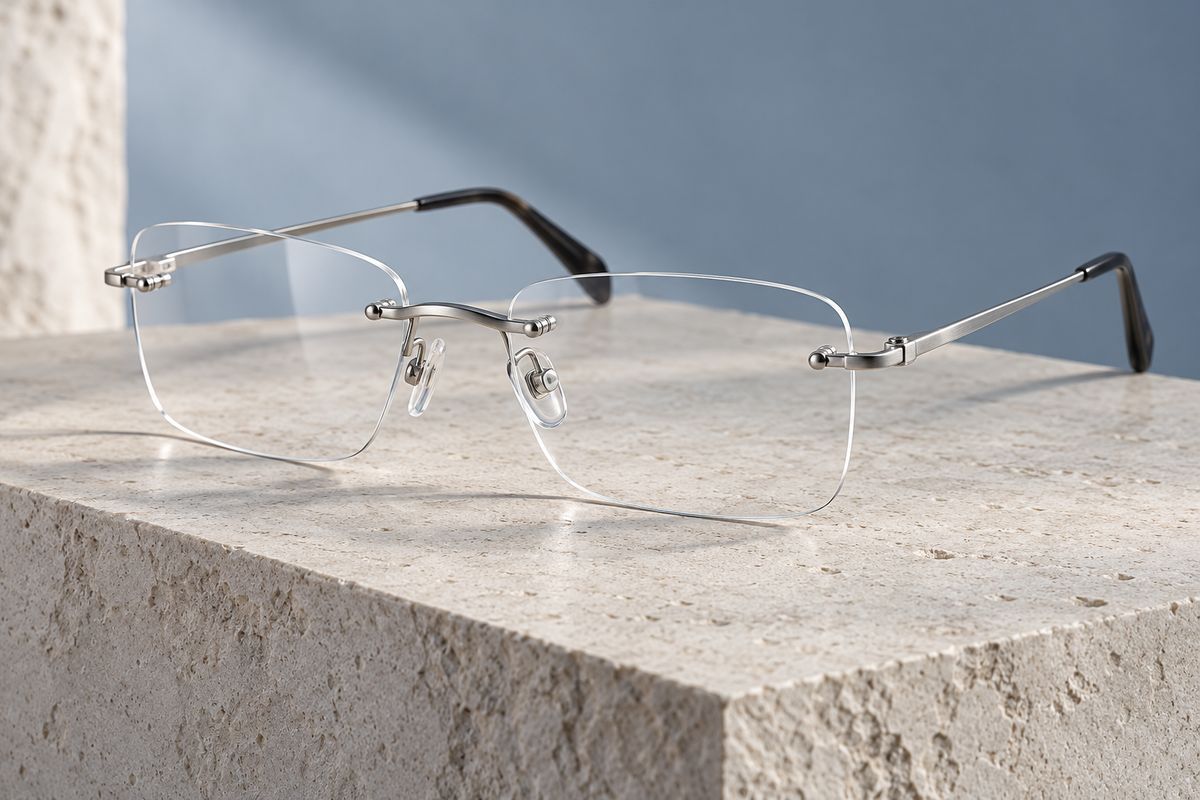
Rimless glasses have no rim surrounding either lens; the bridge and temples connect directly to the lenses. Semi-rimless glasses retain a partial rim, often across the top, with a thin cord commonly securing the remaining lens edge. Both can look understated, but they are different constructions—not two names for the same thing.
If you are comparing them online, start with the lens perimeter rather than the color or thickness of the arms. That one detail helps you identify what you are looking at before thinking about style, fit and customization.
Cover image: AI-generated editorial illustration of generic fully rimless glasses. It does not depict an actual Rimless Wear product or a semi-rimless frame.
The easiest way to tell the difference
Look closely at the top edge of each lens. Is there a continuous metal or plastic rim following it? If so, and only part of the lens is surrounded, it is a semi-rimless design. In the common nylon-cord version, the cord sits in a groove around the uncovered portion of the lens. Not every partial-rim layout is identical; some place the visible rim elsewhere.
With a typical modern rimless pair, the lens outline is exposed all the way around, apart from the small attachment areas. The bridge joins the lenses near the nose, while the temples connect at the outer sides. Small fittings can still be visible: “rimless” does not mean there are no structural components.
Rimless, semi-rimless and full-rim at a glance
| Construction | What surrounds the lens? | What to look for in photos |
|---|---|---|
| Rimless | No surrounding rim. | Exposed lens outline with bridge and temple attachments. |
| Semi-rimless or half-rim | A partial rim; a cord commonly supports the remaining edge. | A visible rim along only part of the lens. |
| Full-rim | A continuous rim around the whole lens. | A complete border, whether thin, thick or transparent. |
A clear plastic frame is still full-rim if it surrounds the entire lens. A very thin metal frame is also full-rim if the border is continuous. Neither becomes rimless simply because the material is hard to see.
Which look do you want: an outline or an accent?
Think of the choice as where you want the visual detail to sit.
- Rimless: start here if you prefer the lens shape, bridge and temple details to carry the design without an enclosing border.
- Semi-rimless: consider this if you enjoy a defined line along part of the lens but do not want a complete rim.
- Full-rim: consider this if an all-around outline is an important part of the look you want.
These are style preferences, not personality types or rules about age, gender or profession. Rimless does not have to mean conservative: a geometric lens or distinctive temple can make a statement. Equally, a slim full-rim pair can look restrained.
For a useful comparison, look at pairs with similar lens dimensions. Comparing a small rimless oval with a large, dark half-rim rectangle changes several things at once. You may be responding to the size, shape or color rather than the construction.
Why rimless construction matters for customization
At Rimless Wear, the frame design does not determine the lens shape. Customers can customize shape, size and style separately from the chosen frame hardware. You do not have to keep the lens outline shown in a frame photograph.
For example, you might like a particular temple design but want a different lens silhouette. Treat those as separate choices: first identify the hardware you like, then explore the lens outline and dimensions. The finished combination still needs to be suitable for the prescription, mounting and fit.
With a conventional full-rim or semi-rimless frame, the existing rim constrains the lens outline. That is why choosing a frame and choosing a custom rimless lens shape are not the same shopping process.
Explore the Rimless Wear frame selection, then use our lens shape and size guide to consider the separate lens decision. The Help Center explains the live try-on tools for previewing shapes and sizes; use the preview as a visualization aid alongside physical sizing references.
Do not use the rim label as a fit or prescription shortcut
A minimal appearance is not a measurement of finished weight or a guarantee of comfort. Compare the actual pair, including the lenses, and check bridge fit, overall width and temple fit rather than choosing on the construction name alone.
The label also cannot confirm whether a particular lens design will work. Discuss your prescription, lens material, selected dimensions and mounting requirements with the provider. If you want progressives, fitting measurements and usable lens height need attention too; see our rimless progressive-lens guide.
Nor should a more substantial-looking frame be treated as proof of impact protection. Everyday style comparisons are separate from selecting eyewear for a specific safety or sporting requirement.
Three questions to make your shortlist
- What do I want to see around the lenses? No rim, a partial line or a complete outline?
- Which choices do I want to personalize? Separate the hardware, lens silhouette, size and lens options.
- What needs confirming before I order? Ask about the final fit and the suitability of your intended lens-and-frame combination.
You do not need to decide which construction is universally “best.” You need to understand what each one is, then compare the details that matter for your own pair.
Frequently asked questions
Are half-rim and semi-rimless glasses the same?
Those terms commonly describe partial-rim frames. Check the product photographs and construction details, because the visible rim is not always in the same position.
Are frameless glasses the same as rimless glasses?
“Frameless” is commonly used for fully rimless glasses. Since descriptions can be loose, confirm that there is no surrounding rim rather than relying on the name alone.
Does rimless mean the lens shape is fixed?
No. At Rimless Wear, customers choose the frame hardware and can customize the lens shape, size and style separately.
Construction references checked October 19, 2026: ZEISS on frame-and-lens combinations and Glasses Direct’s frame-construction definitions. Rimless Wear customization details were checked against its current Help Center.