
News / October 25, 2026
Can Rimless Glasses Have Photochromic Lenses? A Practical Guide
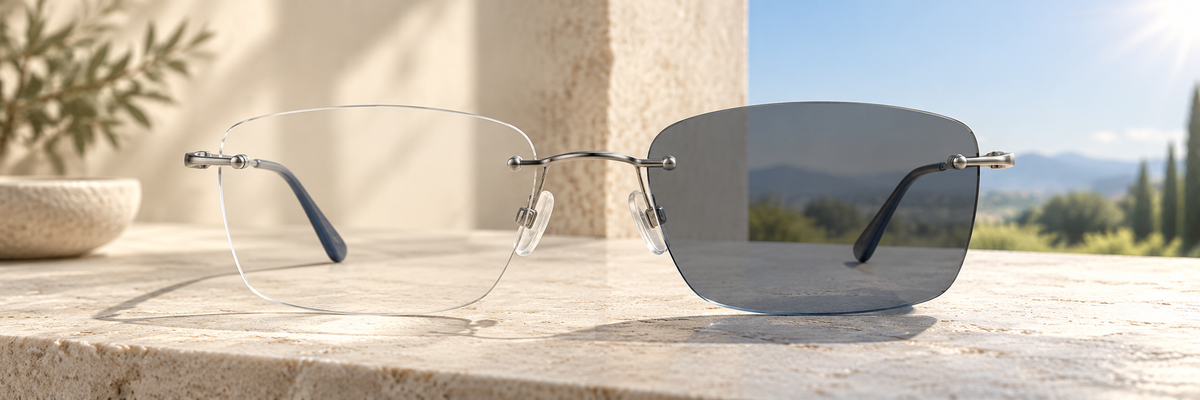
Yes—rimless glasses can have photochromic lenses. These light-adaptive lenses are usually clear or nearly clear indoors and darken automatically outdoors. They can be made with prescription or non-prescription optics when the selected lens material, prescription, shape and size are compatible.
For rimless eyewear, photochromic technology changes what the lenses do in different light; it does not change how the frame is constructed. The bridge and temples still attach directly to the lenses, leaving the lens edges visible.
The cover image is an AI-generated concept created to explain clear-to-dark lens adaptation. It is not an actual Rimless Wear product photo or customer result.
What are photochromic lenses?
Photochromic lenses contain light-sensitive technology that changes the amount of tint in response to the environment. Outdoors, ultraviolet light activates the lenses and makes them darker. When that activating light is removed, the lenses gradually return toward their indoor state.
This creates a convenient two-in-one experience: everyday eyeglasses indoors and sun-responsive lenses outdoors. The change is automatic, so there is no separate clip-on piece to attach.
Rimless Wear currently offers photochromic choices, including Transitions Gen S, through its lens-customization process. Available combinations can depend on prescription, lens material, lens design and the other options selected for the order.
Do photochromic lenses work differently in rimless glasses?
The light-adaptive technology works in the lens, not in the surrounding frame. A rimless mounting does not prevent the lens from changing tint. What is different is how visible the lens itself becomes.
- When clear: the open construction creates a light, minimal appearance.
- When activated: the chosen lens shape becomes more visually noticeable because the tint defines its outline.
- At the edges: rimless lenses have exposed edges, so material, thickness and finishing can influence the finished look.
This makes lens shape especially expressive. A soft oval may look understated indoors and more defined outdoors, while a geometric or angular shape can become a stronger style feature as the lenses darken.
What should you expect indoors, outdoors and in a car?
| Situation | Typical photochromic behavior | What to consider |
|---|---|---|
| Indoors | Clear or nearly clear, depending on the product | Some extra-dark product families may retain a slight indoor tint. |
| Bright outdoors | Darkens automatically | Final darkness and speed vary with UV exposure, temperature, lens material and product type. |
| Moving between spaces | Changes gradually rather than instantly | Allow time for the lenses to activate or fade. |
| Inside a car | Standard photochromic lenses may darken less | Most windshields block much of the UV that activates conventional photochromic technology. |
Driving is one of the most common questions. According to Transitions Optical, standard photochromic lenses may not darken sufficiently behind a windshield because the glass blocks much of the activating UV light. Specialized choices such as XTRActive are designed to respond to additional visible light and can provide more activation in the car, although performance still depends on conditions.
Photochromic lenses, fixed-tint sunglasses or polarized lenses?
These options solve different problems. The best choice depends on where and how you plan to wear the glasses.
| Lens choice | Best known for | Main trade-off |
|---|---|---|
| Photochromic | Automatic adaptation from indoor to outdoor light | The tint changes with conditions and may be lighter in a car. |
| Fixed tint | Consistent sunglass color and darkness | Remains tinted indoors. |
| Polarized fixed tint | Reducing reflected glare in bright outdoor settings | Does not automatically return to clear indoors. |
| Photochromic polarized option | Adaptive tint with polarization in suitable bright conditions | Availability and performance depend on the specific product and configuration. |
Rimless Wear currently lists a Polarized XTRActive Transition option in gray. If your main priority is strong, consistent sun coverage, compare it with the fixed, gradient, mirrored and polarized choices described in our rimless sunglasses lens guide.
Can photochromic rimless glasses use a prescription?
Yes, photochromic technology can be paired with many prescription designs, including common single-vision and multifocal configurations, when compatible. The prescription and fitting measurements still determine how the corrective optics are positioned in the lens.
For progressive or bifocal lenses, shape and height need enough usable area for the required viewing zones. A style that looks appealing should also support the prescription design. Your eye-care professional can help confirm the appropriate lens design and measurements for your individual prescription.
Does the frame design determine the lens shape?
No. At Rimless Wear, the frame design does not determine the lens shape. The hardware is the foundation, while the lenses can be personalized separately. You can choose a shape, adjust its size and select available lens options—including a compatible photochromic treatment.
The custom rimless glasses guide explains the full process. You can also review the lens-size guide to understand width, height and overall frame-width relationships before ordering.
How shape and size affect the finished look
Clear lenses let the frame hardware and your facial features take visual priority. Once photochromic lenses darken, the lens outline becomes part of the style. Consider these practical examples:
- Smaller rounded shapes: compact, subtle and softly defined when activated.
- Rectangular shapes: crisp, structured and easy to coordinate with a professional look.
- Oversized shapes: create more visible tinted area and a stronger sunglass effect.
- Geometric shapes: make the changing tint feel more design-forward and distinctive.
Larger lenses can also affect weight, thickness and prescription suitability. Do not choose size from appearance alone; compare it with your current glasses and provide the required prescription and fitting measurements.
What affects how dark or fast the lenses change?
Photochromic performance is not identical in every setting. Transitions Optical notes that temperature, UV exposure and lens material can affect activation and fading. Cold conditions may change the rate at which the molecules respond, while heat can influence how dark the lenses become.
That means two outdoor moments can look different even with the same pair. Direct midday sun, a shaded patio, a cold winter walk and a warm car interior do not provide the same activating conditions.
A simple way to choose
- Start with your routine. Decide whether you mostly move between indoors and outdoors, drive frequently or spend long periods in bright sun.
- Choose the performance type. Compare everyday photochromic, extra-active and polarized options where available.
- Select your lens shape and size. Think about both indoor transparency and the stronger outline created outdoors.
- Add your prescription details. Upload, photograph, enter or provide them later during the ordering process.
- Confirm compatibility. The final combination should work with the prescription, lens material, measurements and selected treatments.
If reflections and maintenance also matter to you, see our guide to lens coatings for rimless glasses. A coating and a photochromic treatment perform different jobs, and compatible options may be combined depending on the lens package.
Frequently asked questions
Are photochromic lenses the same as Transitions lenses?
Photochromic is the general lens category. Transitions is a brand of photochromic lens technology.
Do photochromic lenses become completely clear indoors?
Many everyday designs are intended to return to clear indoors. Some specialized extra-dark designs may keep a slight tint. Check the specific product rather than assuming all photochromic lenses behave identically.
Will photochromic rimless glasses darken behind a windshield?
Standard photochromic lenses may show limited activation because most windshields block much of the UV light they use. Some specialized products are designed for more in-car activation, but they still do not behave exactly like fixed sunglasses in every condition.
Can I choose any lens shape with photochromic lenses?
You can choose the lens shape independently from the frame design, but the final combination must remain compatible with your prescription, dimensions, lens material and manufacturing requirements.
Are photochromic lenses a replacement for sunglasses?
They can be a convenient everyday alternative for many situations. A fixed or polarized sunglass lens may still be preferable when you want consistent darkness or dedicated glare reduction. The better choice depends on your routine and visual needs.
One pair, two lighting moods
Photochromic lenses can make custom rimless glasses feel especially versatile: open and minimal indoors, then more defined outdoors. The key is to choose the technology for your real routine and treat lens shape, size, prescription and light-adaptive performance as connected—but separate—decisions.
Explore custom rimless glasses and build the combination that suits your style and lens needs.