
News / October 28, 2026
Can Rimless Glasses Correct Astigmatism? CYL & Axis Explained
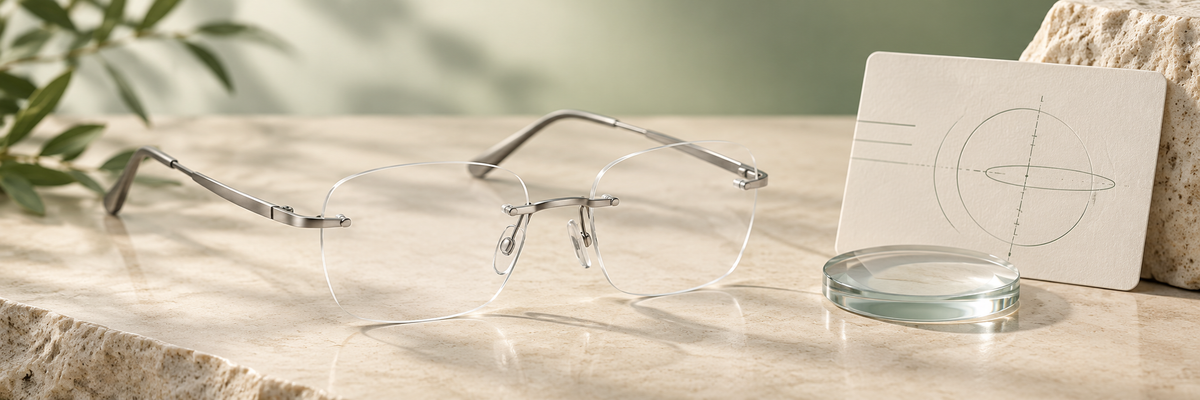
Yes—rimless glasses can often be made with an astigmatism prescription. Astigmatism is corrected through the prescription values placed into the lenses, not by adding a visible rim around them. The important details are the complete glasses prescription, accurate measurements, lens material and dimensions, and whether the finished lenses are suitable for a rimless mounting.
Two prescription fields are especially important: CYL, which states the amount of astigmatism correction, and AXIS, which states its orientation. These values do not tell you what the outside lens shape must look like. With custom rimless eyewear, the frame design does not determine the lens shape; customers can choose the shape, size and style separately, subject to prescription and manufacturing suitability.
Cover image: AI-generated conceptual editorial artwork. It is not an actual Rimless Wear product, prescription or customer result.
What is astigmatism?
Astigmatism is a refractive error in which the eye does not focus light evenly. It can occur on its own or alongside nearsightedness or farsightedness. Eyeglasses can correct many astigmatism prescriptions by incorporating cylindrical power at a specified orientation.
This is general product education, not a diagnosis or individualized medical advice. An eye-care professional should examine your eyes, determine whether astigmatism needs correction and provide the current prescription used to make your glasses.
What do CYL and AXIS mean on a glasses prescription?
A glasses prescription may include SPH, CYL and AXIS for each eye. They describe different parts of the optical correction:
| Prescription field | What it describes | What to check |
|---|---|---|
| SPH (sphere) | The main lens power used for nearsightedness or farsightedness | Copy the plus or minus sign and number exactly |
| CYL (cylinder) | The amount of lens power used to correct astigmatism | Do not omit or change its plus or minus sign |
| AXIS | The orientation of the cylinder correction, written in degrees | Enter the complete value exactly as prescribed |
The American Academy of Ophthalmology explains that cylinder represents the astigmatism correction and axis identifies its direction. AXIS is not a strength scale: a larger axis number does not automatically mean a stronger prescription. It is an orientation and is meaningful together with CYL.
Lens shape and cylinder are not the same thing
The word “shape” can create confusion here because it is used in two different ways:
- Lens shape is the visible outside outline—round, oval, rectangular, cat-eye, geometric or a custom design.
- Cylinder correction is an optical component built into the prescription lens to correct astigmatism.
The outside outline does not need to resemble the direction of the astigmatism. Do not rotate, round or change an AXIS value to match a lens outline. The prescription values guide the optical preparation; the custom outline guides the style and physical dimensions.
Rimless Wear currently lets customers choose the frame and then personalize the lens shape, size and available lens options. That means an oval or geometric shape can potentially use the same astigmatism prescription when the complete design is suitable. The frame model itself does not lock the customer into one lens shape.
What makes an astigmatism prescription suitable for rimless glasses?
There is no single CYL or AXIS number that answers the question by itself. Suitability depends on the complete order, including:
- The full prescription: SPH, CYL and AXIS work together, and ADD or prism instructions may also matter when present.
- Lens type: Astigmatism correction can be part of single-vision, progressive or bifocal glasses when the chosen design is suitable.
- Lens material and index: The prescription and dimensions influence finished thickness, weight and available material choices.
- Shape and size: Width, height and outline affect how much material is used and where the mounting points can be placed.
- Optical measurements: PD and any required fitting measurements help place the correction correctly in front of the eyes.
- Rimless mounting: The bridge and temples attach directly through the lenses, so the selected material and drilling areas must be appropriate for the complete design.
A higher CYL value does not automatically rule out rimless glasses, but it can make accurate prescription entry and lens preparation especially important. Rimless Wear does not publish one universal astigmatism limit on its customer-facing pages; current availability should be confirmed against the entire prescription and selected design rather than guessed from one number.
How lens size can affect the finished result
Rimless eyewear leaves the lens edges visible, so prescription, material and dimensions all contribute to the final appearance. A larger outline generally uses more lens area. For some prescriptions, a smaller or more balanced design may help manage weight or visible edge thickness, but the effect depends on the full optical calculation and pupil position.
Use the lens and overall-width sizing guide to compare dimensions in millimetres. A comfortable pair you already own can provide a helpful hinge-to-hinge reference. Live Try-On is useful for comparing visual proportions, but it does not validate the prescription or replace the measurements needed to prepare the lenses.
Which lens type should you choose?
Astigmatism does not decide whether the glasses should be single vision or multifocal. That choice depends on the intended viewing ranges and the prescription:
- Single vision: one primary viewing range, such as distance, reading or computer work.
- Progressive: a gradual transition between distance, intermediate and near ranges.
- Bifocal: two viewing areas, commonly distance and near, separated by a visible line.
The single-vision lens guide explains those task-specific choices in more detail. If the prescription includes ADD, ask the prescribing professional which lens type and working range the prescription is intended to support.
Why PD still matters
PD, or pupillary distance, does not measure astigmatism. It helps position the optical correction relative to the pupils. CYL and AXIS describe the cylinder correction; PD helps place the finished lenses correctly in front of the eyes. These measurements work together rather than replacing one another.
Review the PD guide for rimless glasses for an explanation of single and dual PD. Use the measurements requested for the selected lens design and do not estimate a missing value.
How to order rimless glasses with astigmatism
- Start with a current glasses prescription. A contact lens prescription contains different information and should not be used as an eyeglass prescription.
- Choose the frame you like. Select its available color or hardware finish.
- Choose the lens outline separately. Pick a shape, refine the dimensions in millimetres and compare the proportions.
- Select the appropriate lens type. Choose distance, reading, computer, progressive or bifocal according to the prescription and intended use.
- Submit every prescription value accurately. Include CYL and AXIS for each eye exactly as written, along with SPH, ADD, prism or other instructions when present.
- Provide the requested measurements. Enter PD and any additional fitting information required for the lens type.
- Review material and coatings. Available index and coating choices depend on the selected lens. The high-index lens guide explains how index, size and prescription interact.
Rimless Wear’s current ordering FAQ says customers can upload a prescription, provide a photo, enter details manually or send it later. If any value is unclear, confirm it with the prescribing professional before the lenses are prepared.
Frequently asked questions
Can rimless glasses correct astigmatism?
Often, yes. Astigmatism correction is built into the prescription lenses through CYL and AXIS values. Final rimless suitability depends on the complete prescription, lens material, dimensions and mounting design.
Does a high CYL value mean I cannot wear rimless glasses?
Not by itself. CYL is only one part of the prescription. The full combination of SPH, CYL, AXIS, lens size, material, optical measurements and mounting requirements needs to be reviewed.
Does the lens outline need to match my AXIS?
No. AXIS is the orientation of the astigmatism correction, while the visible lens outline is a style and sizing choice. The two should not be confused.
Can progressive rimless glasses include astigmatism correction?
They can when the prescription and selected progressive design are suitable. Lens height, PD and other fitting measurements remain important for progressives.
Can I use my contact lens prescription?
No. Contact lens and eyeglass prescriptions are not interchangeable because contacts sit on the eye and include different fitting information. Use a current prescription specifically written for glasses.
Can I still customize the lens shape and size?
Yes, subject to prescription and manufacturing suitability. The frame design does not determine the lens shape. Customers can customize shape, size and style separately when building rimless eyewear.
What should I do if CYL or AXIS is blank?
Do not invent a value. A blank field may mean no cylinder correction was prescribed for that eye, but prescription formats vary. Ask the prescribing office if anything is unclear.
Clear prescription, custom outline
Astigmatism changes the optical instructions inside the lens; it does not remove the creative freedom of rimless eyewear. Begin with a current, complete glasses prescription, keep CYL and AXIS exactly as written, and then explore the frame, shape and millimetre sizing that suit your style. The finished combination should be confirmed for optical and manufacturing suitability before production.
Sources and availability check: Checked October 28, 2026. Rimless Wear’s current custom-eyewear and FAQ pages were used to verify prescription categories, submission methods and shape-and-size customization. General CYL, AXIS and astigmatism information was cross-checked against the American Academy of Ophthalmology’s eyeglass-prescription guide and astigmatism information. Available lens options can vary with the complete prescription and selected design.